
Description
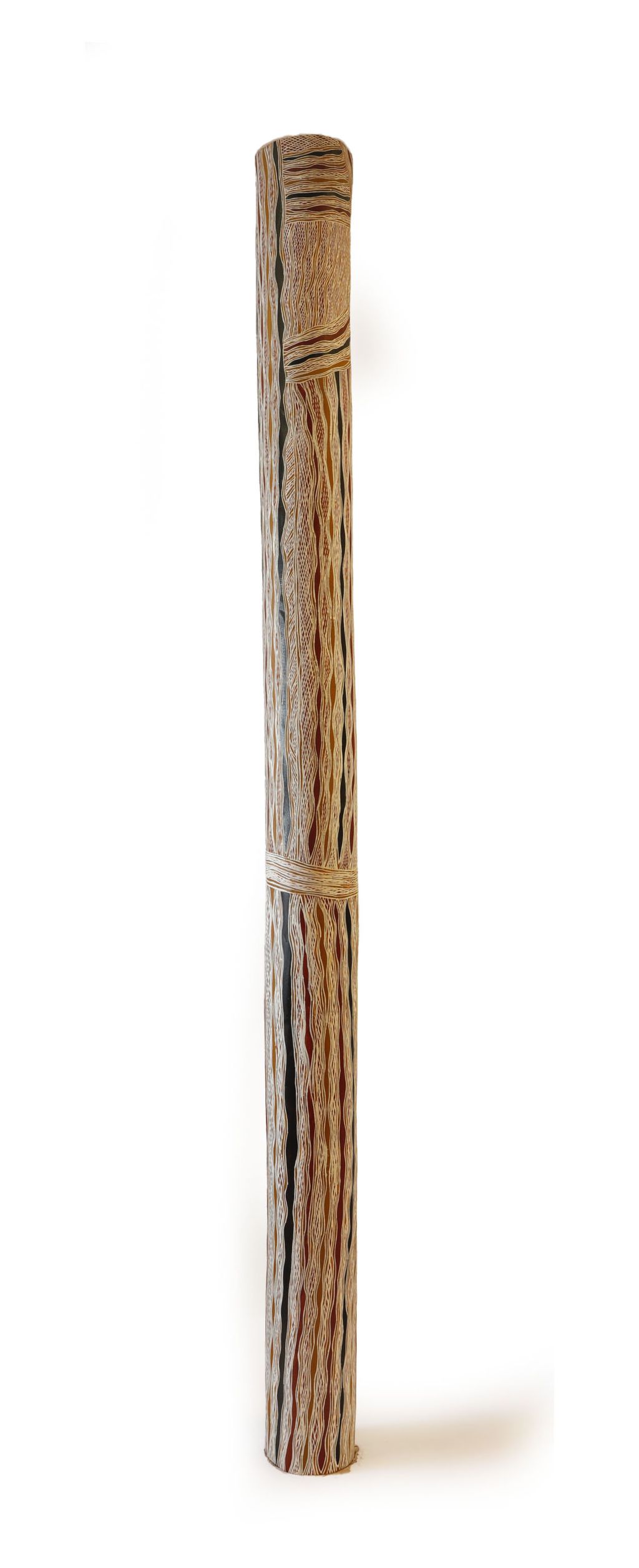
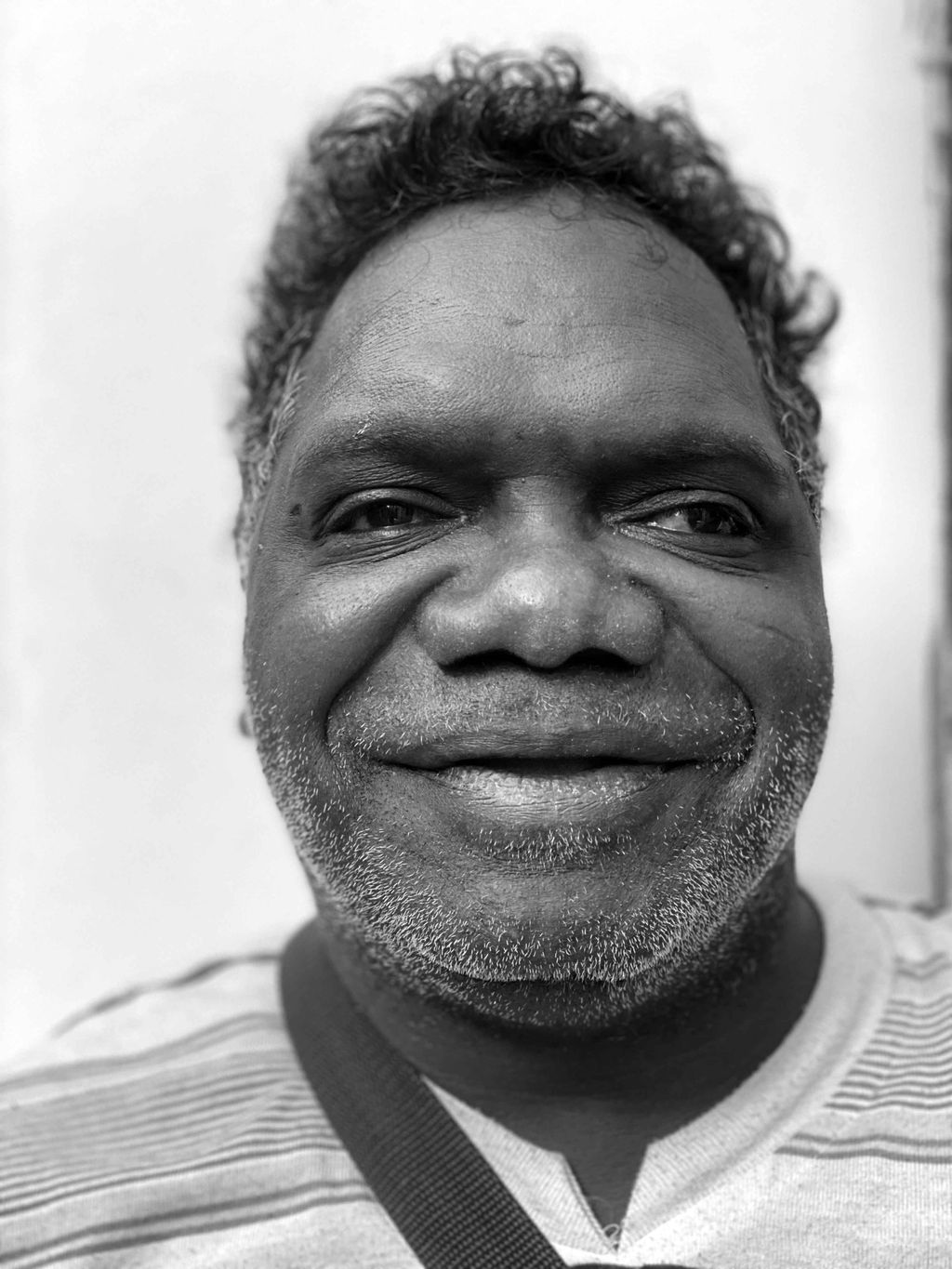
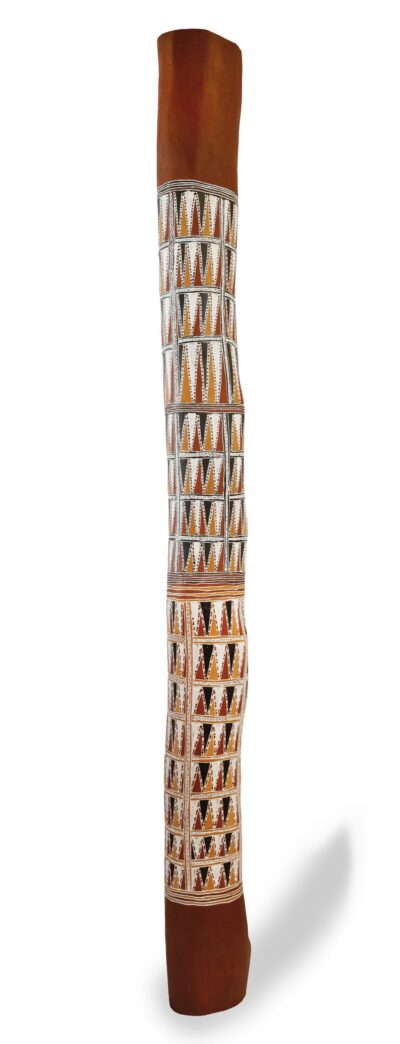
munuminya marawili
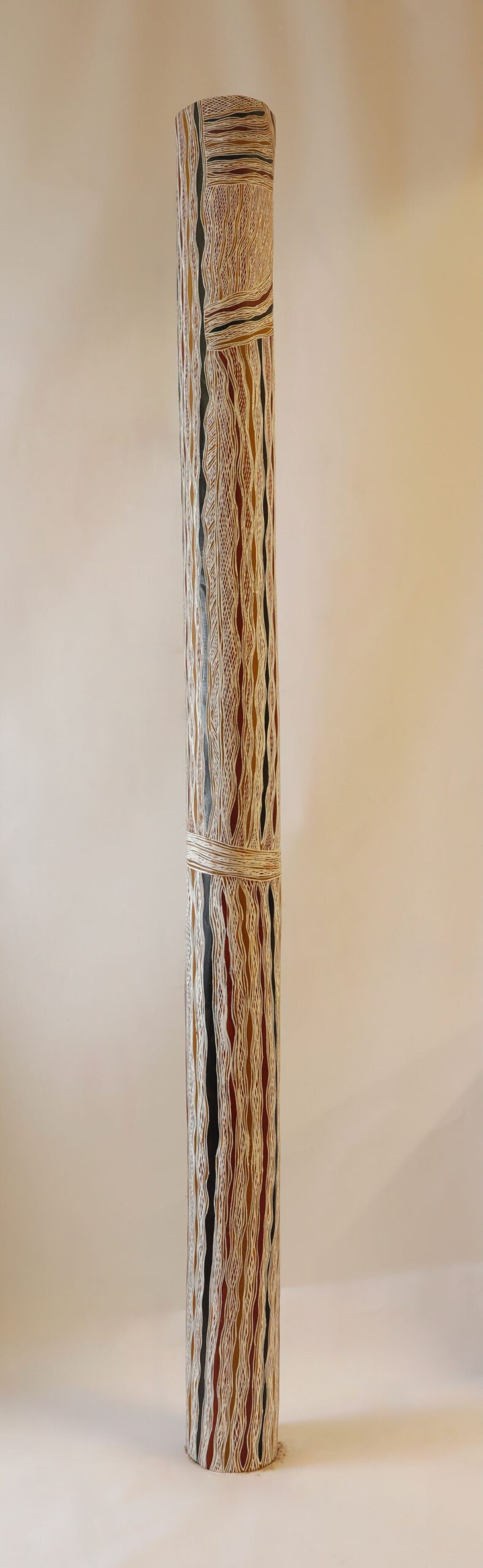
Earth pigments on Stringybark hollow pole
220 x 16cm
Year: 2025
ID: 2341-25
Mundukul/Burrut’tji
Baraltja is the residence of Burrut’tji (also known as Mundukul) the lightning serpent. It is an area of flood plains that drain into northern Blue Mud Bay. It is on country belonging to the Maḏarrpa and denotes an area of special qualities pertaining to fertility and the mixing of waters.
From Maḏarrpa (and Dhalwaŋu clan) land freshwater spreads onto the Baraltja flood plains with the onset of the Wet. A tidal creek into the Bay flows with the freshwater flushing the brackish mix into the sea over an ever shifting sandbar (the snake manifest). The deep hole that he lives in is Lorr.
Freshwater enters the tidal mud flats at Baraltja that is residence of the Lightning Snake for the Maḏarrpa. The lightning Snake facing upstream, upon tasting the freshwater coming down stands on his tail and by way of spitting lightning into the sky communicates with the Ṉuŋurrdulpuyŋu and his contemporaries from other associated clans.
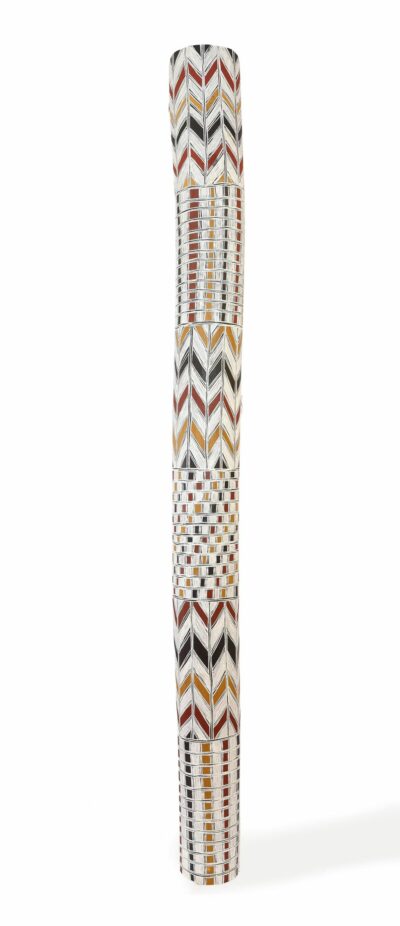
The same can be said for the other who faces towards the south towards another Maḏarrpa area called Guminiyawiny, Numbulwar way, producing storm fronts and boomerang shaped jet streams with its message. These events are sung with the aid of Napunda the boomerang shaped click sticks that are represented by the same shapes of the jet-steams that feather the storms front. Songs associated with Baraltja are normally intoned at the completion of men’s ceremony for the Maḏarrpa and associate clans.
So as a harpoon travels or does lightning the estates are connected spiritually in a multi directional way – both to and from, a cyclic phenomenon which is chronicled in the sacred songs that narrate these Ancestral actions over land, through the sea and ether.
It is worth noting that Yolŋu ‘science’ portrays this energy burst as coming up from the land which is now recognised by Western science as the precursor to downward lightning ‘strikes’.
The Larrakitj had its traditional use for the Yolŋu of North east Arnhem Land as an ossuary or bone container erected as a memorial to a dead kinsman up to a decade after death. After death the body of the deceased was often ceremonially placed on a raised platform and left to the elements for an appropriate time. The area would then be abandoned until the next stage of the ritual.
This took place once it was determined that the essential eternal spirit of the deceased had completed its cyclical journey to the spring from which it had originated and would in time return again. This might be several years. Whilst the body was ‘lying in state’ others got wind of the death, perhaps by subliminal message and made preparations to journey to the site of mortuary. Usually enough time had elapsed for the bones of the deceased to be naturally cleansed on the platform. The essence of the soul within the bone was made ready for final rites when other outside participants necessary for its safe journey arrived. Ritual saw the bones of the deceased placed within the termite hollowed memorial pole for final resting. Mortuary ritual would end with the placement of the Larrakitj containing the bones standing in the bush. Over time the larrakitj and its contents would return to mother earth.
The Larrakitj has often been referred to as the mother’s womb. Once sedentary mission communities were established in Arnhem Land it became impractical to abandon permanent communities and outlawed to expose corpses on platforms. However the cosmology of the Yolŋu and the essence of ritual mortuary ceremony remains just as important. Larrakitj continue to be produced as the equivalent of headstones or to contain the personal effects of a deceased (which might be dangerous unless removed from the living because of the emanations imbued by contact with the deceased).
A further role for this cultural form is as a fine art object and an instructional tool for younger generations. Artworks of this nature have multiple layers of metaphor and meaning which give lessons about the connections between an individual and specific pieces of country (both land and sea), as well as the connections between various clans but also explaining the forces that act upon and within the environment and the mechanics of a spirit’s path through existence. The knowledge referred to by this imagery deepens in complexity and secrecy as a person progresses through a life long learning process.
Reviews
There are no reviews yet.