Description
matati gumana
Earth pigments on Stringybark
115 x 47cm
Year: 2026
ID: 1828-26
Munbi
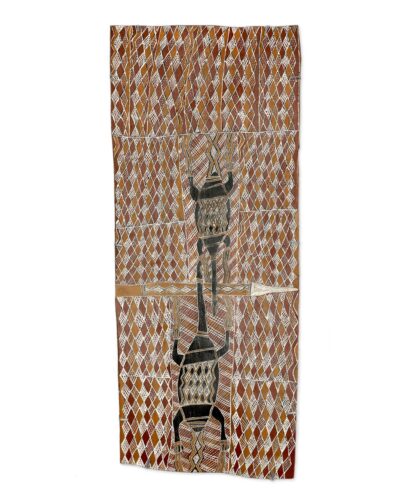
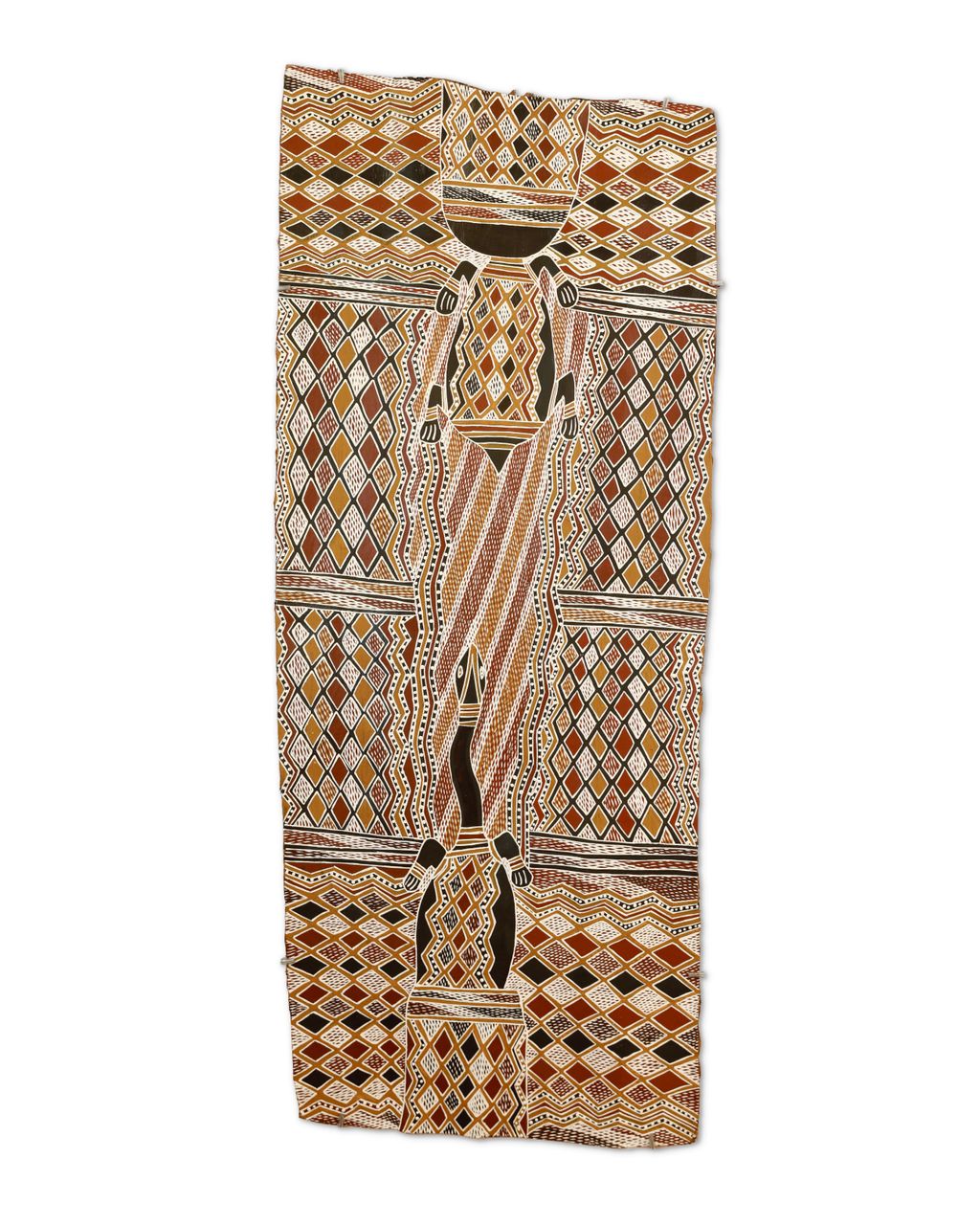
The miny’tji or sacred clan designs that adorn this work, belong to the Dhalwangu clan and show the place of the production of this work, Gäṉgaṉ. Gäṉgaṉ is the point of origin of the whole Yirritja moiety. This is represented by the diamond patterning – of the sacred freshwaters contaminated by silts stirred from the bottom of profound water holes.
Barama the Ancestral Creator Being directed the instigation of lore for the Yirritja. It is said that during the times of Waŋarr, the period of the first mornings, after travelling from the coast of Blue Mud Bay, he emerged from a freshwater billabong at Gäṉgaṉ. The water imbued with the mud of this place streaming down his chest struck by the sunlight made this design which has distills the identity of Gäṉgaṉ and its people.
Barama carried a sacred staff symbolic of deep seated knowledge and with weed hanging from his arms and water steaming from his body he strode ashore. Here at Gäṉgaṉ he met with others, his disciples and initial ceremony was performed for the Yirritja moiety – given to the Dhalwaŋu. From here the Creator Beings travelled to what was to become Yirritja land, giving law, language, song, dance, totems and madayin (restricted business) to the Yolŋu.
Minhala, the long necked tortoise is a totem for the Dhalwaŋu and witnessed the events in these waters. He himself became imbued with the power of Barama and is a manifestation of that being. Artworks of this nature have multiple layers of metaphor and meaning which give lessons about the connections between an individual and specific pieces of country (both land and sea), as well as the connections between various clans but also explaining the forces that act upon and within the environment and the mechanics of a spirit’s path through existence.
The knowledge referred to by this imagery deepens in complexity and secrecy as a person progresses through a life long learning process. A sacred expanse of water behind the Gangan outstation where this work was produced is referred to as Gulutji. The initial activities of Barama the great Ancestral Being for the Yirritja moiety took place here. From travelling from the seaside at Blue Mud Bay he emerged from the waters of Gulutji. Council was held with ‘Disciple’ Ancestors and Yirritja Law was ‘written’. From this place the Yirritja (the Yirritja moiety together with the Dhuwa moiety forms a duality system that keeps all past, present and future life in balance) nation spread as it traversed its country establishing clan estates and governing policy including language, ceremonial ritual and miny’tji (signature of sacred design of event and place- this word describes the patterns employed in this work).
One of the metaphorical overviews of this piece is the union between the different subgroups of the Dhalwangu clan in the ancestral cycle of regular fishtrap ceremonies they join together in celebrating. The last one of these was five years ago. These gatherings are ceremonial but also social and educational. The sacred diamond design generally refers to the waters around Gangan but here are now triangles which show the structure of the fishtrap made during Mirrawarr (early Dry Season) with Rangan (paperbark) and wooden stakes. This is the Buyku or fishtrap area which is ‘company’ land (ie. shared by all the people who live by/sing the river). The Dhalwangu and allied groups who participate in this song cycle and fishing activity are hunting Baypinga (Saratoga) as does the Gany’tjurr (Reef Heron) which they identify with as the archetypal Yirritja hunter. At this place a fish trap was constructed by driving stakes into the banks and across the flow of the river, filling the gaps between them with branches mud and grass. An opening was left in the middle of the trap where a paperbark basket was fixed. Fish up stream were driven down into the trap, when the fish tried to jump over it they were caught.
The artist here refers to Dhalwaŋu totem Minhala (long neck turtle) at its sacred creation site on the freshwater system of Gäṉgaṉ called Munbi. Minhala comes out of its nest from laying its eggs to disappear again under the mud where it will stay during a period of time during the dry season. There are secret elements to Yolŋu custom. Things are hidden away from the main camp away from women and children. Things are brought out only at the appropriate time during ceremony that are symbolic of the deep seated knowledge and power associated with it, then put back in hiding for when it is again needed. The natural behaviour of Minhala is in line with this concept. It hides these sacred life giving activities within its mound or Munbi. The original trap can be seen today manifest as a ‘naturally’ occurring rock barrage. Wurran the diver duck, role model for Yirritja hunters, uses it as a place to hunt Baypinŋa (Saratoga), another totemic species for the Dhalwaŋu. Minhala emerges where the fresh has been muddied by powerful actions hidden under the waters at Gangan near a sacred font that gushes up within the river’s bed itself.