Description
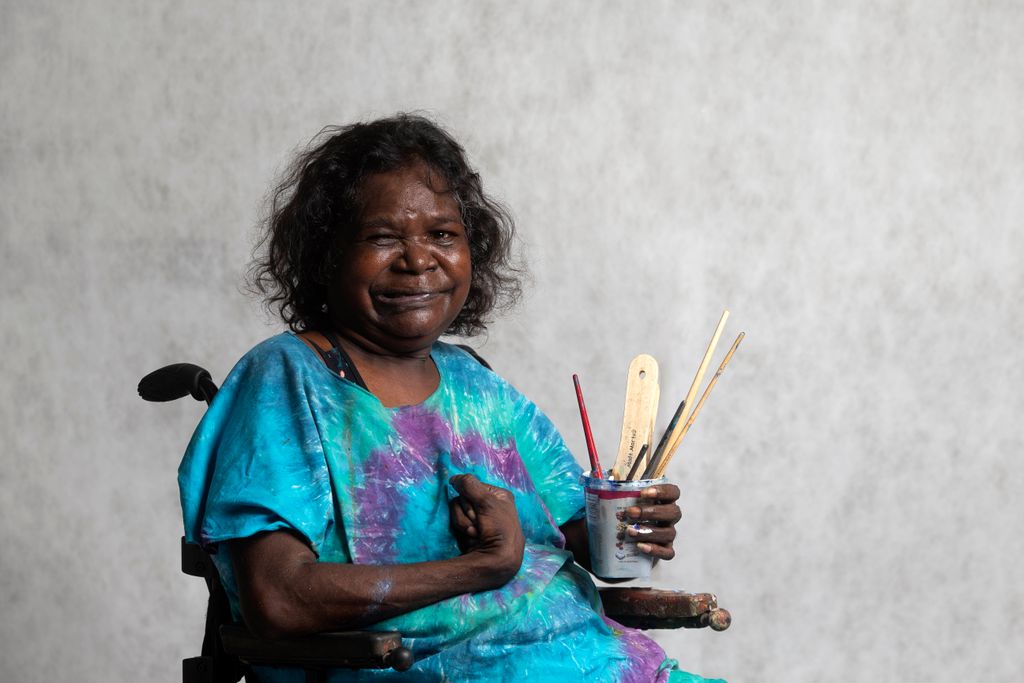
dhambit-ruypu munungurr
Etching
78 x 44cm
Year: 2026
ID: 4021-26
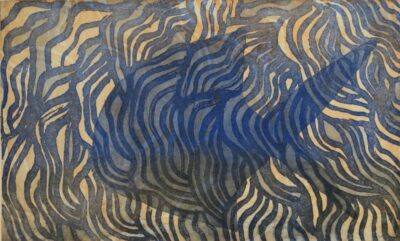
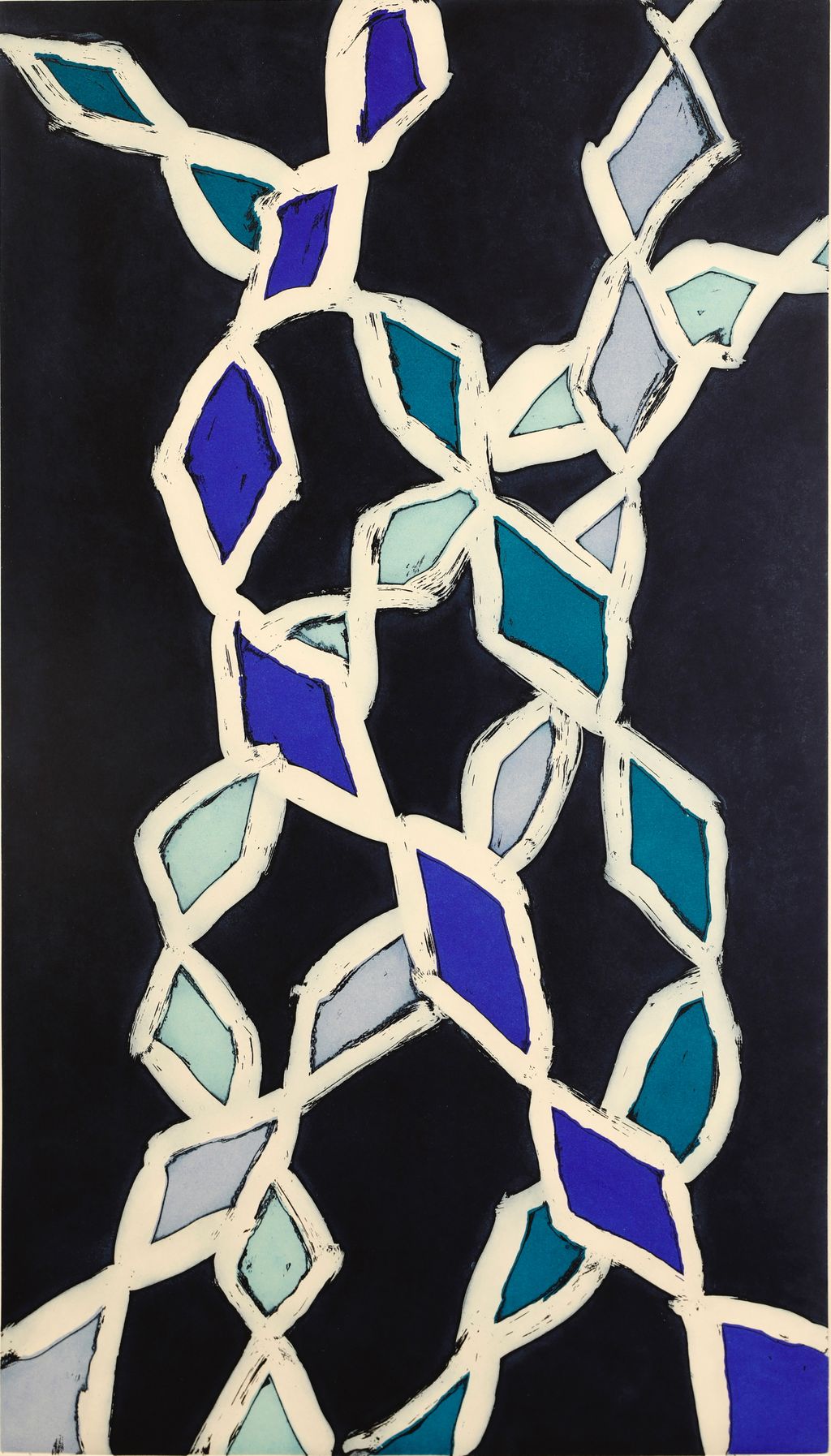
Blue Fire
As told by the artist:
This is about my Mother’s clan. These are her bones inside, skin outside. They live at Birany Birany. This is her homeland, were she rests. She is Gumatj.
Dhambit is the daughter of two winners of the First Prize in the National Aboriginal and Torres strait Islander Art Award, Mutitjpuy Mununggurr and Gulumbu Yunupingu. Her grandfathers are Woŋgu and Munggurrawuy who themselves are legendary leaders and artists. She was hit by a car in 2007 and suffered serious head injuries which were life threatening. Through her husband’s and (now deceased) mother’s persistence and her own courage she has used art to overcome the deficits caused by the accident. She also practised as an artist prior to the accident. Her art is powerful and spontaneous and founded in her deep knowledge of Yolŋu Law. Her art is not ‘disabled’ art and finds acceptance within the community and the market as an innovative vision based on real understanding of the spiritual forces of her Yolŋu country and worldview. Her esoteric knowledge of Yolŋu sacred Law is intact and she is one of the most learned of elders.
She is currently in a wheelchair with restrictions on movement and speech stemming from those head injuries. She paints with her non-preferred left hand. She used art to rehabilitate herself. Painting constantly and selling or giving away art to anyone who showed an interest. She painted and sold her work from home as an independent artist for many years. She used acrylics in ochre colours to overcome the difficulty of grinding the ochres by hand which was beyond her capacity. She often painted on boards to avoid the obstacle of cutting bark. She was supported in all of this by her French partner Tony Gintz who would also cut bark for her but not enough to keep up with her prolific constant creation. As time progressed Dhambit began to include non-earth colours in her work such as green to depict trees. In 2018 she accepted an invitation from her art centre to produce a large bark for inclusion in the Aboriginal Art Award. This autobiographical piece was produced in daily sessions in the courtyard of Buku-Larrŋgay and set the pattern for the next phase of her career. The regard and attention that this piece garnered encouraged further production of large pieces and brought her to the attention of Tony Elwood of the NGV who met her in the courtyard on a visit to Yirrkala. By this stage she had settled on blue as the dominant colour for these large pieces. Elwood invited her to be a major artist in the 2020 NGV International Biennale on the spot.
In ancestral times, the leaders of Yirritja moiety clans used fire for the first time during a ceremony at Ŋalarrwuy in Gumatj country. This came about as fire brought to the Maḏarrpa clan country by Bäru the ancestral crocodile, spread North and swept through the ceremonial ground. From this ceremonial ground the fire spread further to other sites. Various ancestral animals were affected and reacted in different ways. These animals became sacred totems of the Gumatj people and the areas associated with these events became important sites.
The fire spread inland from the ceremonial ground and burnt the nest of Waṉkurra (Bandicoot) forcing him to hide in a hollow log ḻarrakitj to save himself. Waṉkurra is thus danced and sung at mortuary ceremony as he is associated with the burial log used to contain the bones of the deceased.
Djirikitj, the quail (sometimes called the’ fire making bird’), picked up a burning twig from this fire and flew away with it, dropping it at Maṯamaṯa. There is a large paperbark swamp at Maṯamaṯa, where native honey bees live. Fire from the burning twig dropped by Djirikitj took hold of the tall grass in the swamp area and the native bees fled to Djiliwirri in Gupapuyŋu clan country. Thus Gupapuyŋu honey and Gumatj fire are linked through these ancestral events and also refer to a relationship between these two clans which is played out in ceremony.
ThePee-Wee Biḻkpiḻk or Ḏelili built its nest high up in the trees safe from the fire- its song was to be heard after the morning of the fire. The indestructible spider Garr came out after the fire had passed and spun its web between the trees which is said to catch the souls of the Yirritja dead. Garrtjambal the kangaroo was as frightened as Waṉkurra and ran away from the fire burning his feet in the hot ash as he did so. Waṉkurra traveled through the hollow log with its tail on fire transferring the Gumatj identity to new places.
The harbinger of death is Ŋerrk, sulphur crested white cockatoo who is intimately associated with this place, these people and this ceremony. Another powerful Gumatj bird is Djilawurr whose sites are often associated with freshwater rainforest adjacent to the harbours of Macassans.
These creatures are all associated with named sites which were burnt as the ancestral fire spread across the land. Where the sites described occur outside Gumatj clan country, the path of the fire represents important relationships held between these clans.
The Gumatj clan design associated with these events, a diamond design, represents fire; the red flames, the white smoke and ash, the black charcoal and the yellow dust. Also the black skin, yellow fat, white bone and red blood of Gumatj people. Clans owning connected parts of this sequence of ancestral events share variations of this diamond design.
Image size: 78 x 44cm
Paper size: 102.5 x 67cm
Paper: Hahnemuhle